






Getting visitors to your website feels like progress—and it is. But traffic alone does not pay the bills. The real business question is what happens after someone discovers your brand.
Do they understand your offer? Do they trust your business? Can they find the right service? Is there a simple way to enquire? Does the lead receive a timely response? Can your sales team see what happened next?
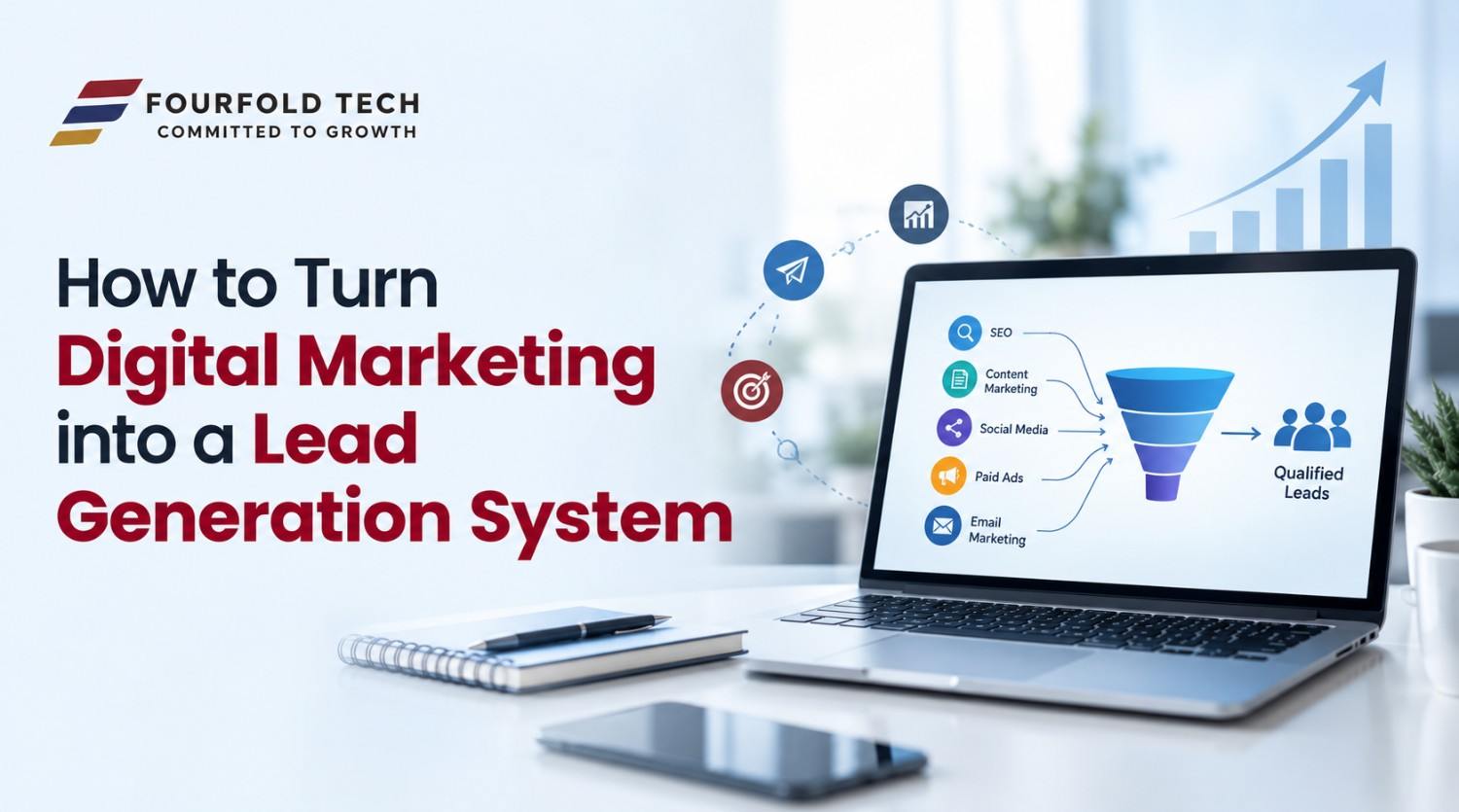
That is why modern digital marketing should be viewed as a lead generation system. SEO, paid advertising, social media, content, email, website conversion and sales follow-up each have a role, but the biggest opportunity often comes from connecting them.
1. Your website is the center of the system
Think of your website as more than a digital brochure. It should explain your value proposition, support different customer journeys and create clear opportunities to take action.
- Service pages should explain the problem you solve and who you solve it for.
- Landing pages should match the intent of the campaign or search query.
- Calls to action should be visible without making the page feel pushy.
- Forms should ask for enough information to qualify the enquiry without creating unnecessary friction.
- Case studies, testimonials and useful content can help build confidence.
Fourfold Tech’s website and digital growth approach is built around connecting technology, marketing and sales rather than treating each service as an isolated activity.
2. SEO brings in people who are already looking
Search can be one of the strongest sources of relevant demand because the user is actively looking for information, a provider or a solution. The opportunity is to create content that matches search intent rather than publishing articles simply to add more pages.
Start with the questions your customers actually ask. Then build a useful mix of service pages, location or industry pages where appropriate, educational articles and problem-solving resources.
Every important content page should have a logical next step. That might be a service page, a consultation request, a downloadable resource or another useful article. SEO should lead somewhere.
3. Paid advertising accelerates targeted testing
Organic visibility takes time to build. Paid search and social advertising can help businesses test specific offers and audiences more quickly. But successful paid lead generation requires more than launching an ad.
- Choose a clear audience and objective.
- Write an offer that addresses a specific need.
- Send traffic to a relevant landing page.
- Track enquiries and downstream outcomes.
- Use the data to improve targeting and messaging.
An ad that generates inexpensive clicks can still be a weak campaign if the resulting leads are poorly qualified. The real test is what happens after the click.
4. Social media should support trust and demand
Social media is often treated as a publishing calendar: create posts, publish them and move on. For lead generation, content should have a job.
- Educational content can demonstrate expertise.
- Industry insights can create relevance.
- Case studies can provide proof.
- Short videos can explain complex ideas quickly.
- Calls to action can move interested people into a conversation.
The strongest social strategy does not try to turn every post into a sales pitch. It builds familiarity and gives the right audience reasons to remember your company when a business need appears.
5. Email turns one interaction into an ongoing conversation
Someone who downloads a resource, makes an enquiry or responds to a campaign has given your business a reason to continue the conversation. Email marketing can help nurture that relationship with useful, relevant information.
Segmentation matters. A new prospect should not necessarily receive the same message as an existing customer or someone who has already spoken with sales. Personalized email campaigns and automation can help businesses maintain consistent communication while reducing repetitive manual work.
6. LinkedIn outreach can open targeted B2B conversations
For B2B businesses, LinkedIn can be particularly useful when the target audience is defined by job role, industry, company size or geography. Rather than sending a generic pitch to everyone, build a focused prospect list and develop messaging around a relevant business problem.
Good outreach should sound like a conversation between businesses—not a mass advertisement. Research, personalization and sensible follow-up can make a significant difference to the quality of the interaction.
7. Lead qualification protects your sales team’s time
Not every enquiry deserves the same level of sales attention. A lead qualification process can help identify fit, need, timing and other useful criteria before a sales conversation becomes too resource-intensive.
Qualification does not have to be complicated. Even a simple scoring or categorization process can help a team separate high-priority opportunities from enquiries that need nurturing or are outside the ideal customer profile.
8. Automation connects the moving parts
When lead generation grows, manual handoffs become difficult to manage. Marketing automation, CRM workflows and lead management tools can help route enquiries, trigger follow-ups, record activity and give sales teams a clearer view of the pipeline.
Fourfold Tech also provides AI and automation solutions for lead qualification, prospect engagement, appointment booking, CRM automation, follow-up sequences and sales pipeline optimization. The purpose is not to remove the human element; it is to reduce repetitive work so teams can spend more time on meaningful conversations.
9. Measure what matters to revenue
A connected system gives you more useful data. Instead of asking only how many visitors or leads a campaign produced, ask:
- Which channels generate qualified leads?
- Which campaigns create sales meetings?
- Which sources produce opportunities?
- Where do prospects drop out?
- How long does it take to move from lead to opportunity?
- Which activities are producing the strongest commercial outcomes?
These questions turn digital marketing from a collection of activities into a process the business can improve.
10. The connected model: attract, engage, qualify, convert
A practical lead generation system can be summarized in four stages.
- Attract — SEO, paid media, social content and targeted outreach bring the right audience into the journey.
- Engage — useful content, strong landing pages and personalized communication build interest and trust.
- Qualify — forms, conversations, automation and CRM processes help identify genuine opportunities.
- Convert — sales follow-up, proposals, meetings and customer onboarding move qualified opportunities forward.
The important part is the connection between stages. If traffic is strong but the website is weak, leads are lost. If lead capture is strong but follow-up is slow, opportunities are lost. If sales feedback never reaches marketing, the same problems repeat.
Final thoughts
Digital marketing becomes much more powerful when it is designed around a business outcome instead of a list of deliverables. Your website, SEO, advertising, content, outreach, email and sales processes should support the same goal: creating relevant conversations with people who have a genuine need for what you offer.
For businesses that are tired of coordinating separate vendors for website development, marketing and sales support, an integrated approach can also reduce the gaps between teams. The goal is a connected growth engine that can be measured, improved and scaled.
A practical next step
If you want to connect your website, SEO, paid media, outreach and sales processes into one lead generation system, Fourfold Tech can help you map the journey, identify gaps and build the right combination of digital marketing, technology and sales enablement for your business.


