







Every business wants more leads. But if you have ever received a spreadsheet full of contacts that never reply, website enquiries that are not a fit, or paid leads that never move toward a sales conversation, you already know the real problem: lead volume and lead quality are not the same thing.
A strong lead generation strategy is not simply about getting more people to fill out a form. It is about reaching the right audience, giving them a reason to engage, capturing useful information, following up consistently, and giving your sales team a clear path to turn interest into opportunity.
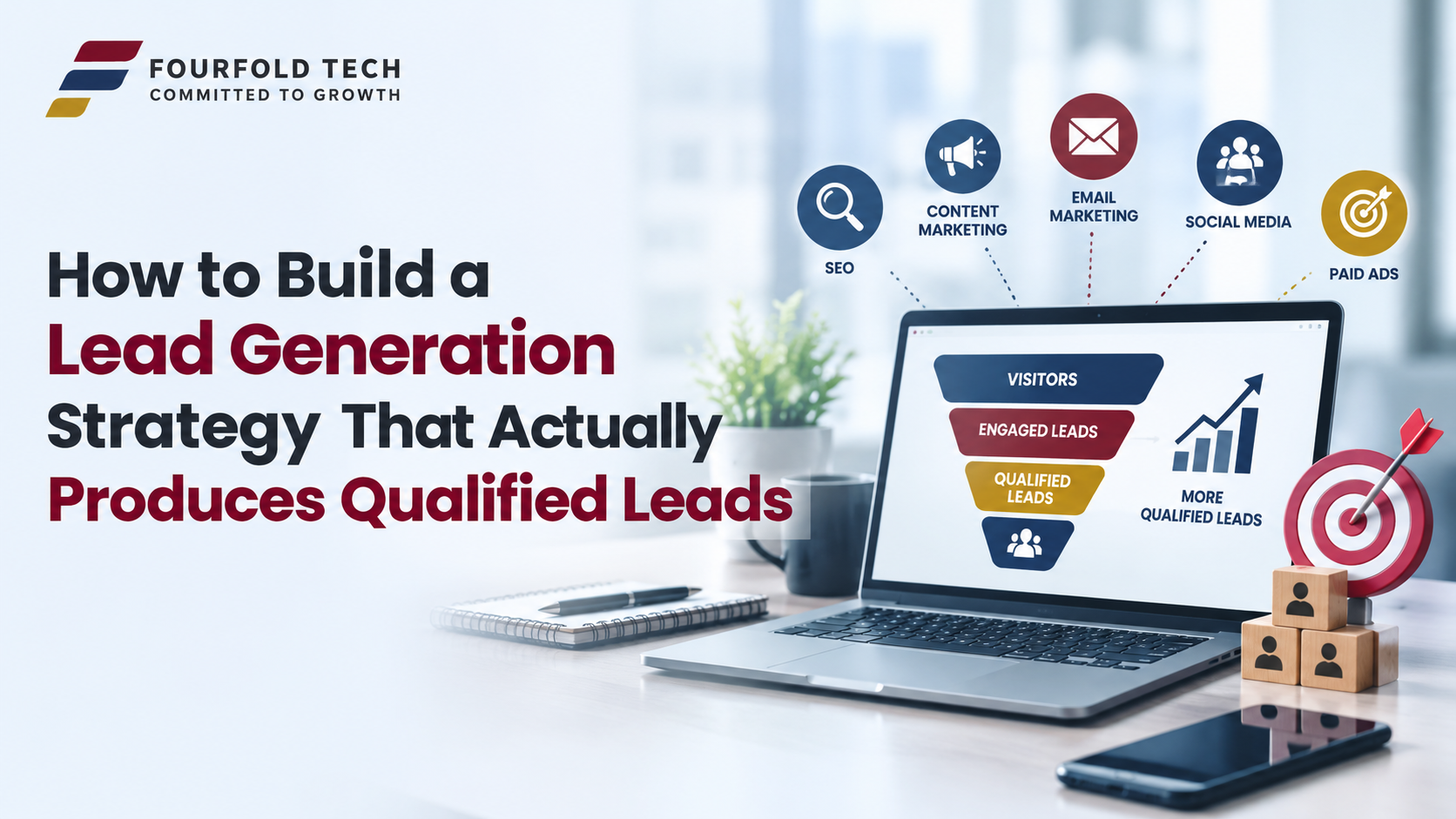
At Fourfold Tech, we approach lead generation as a connected growth process rather than a single marketing activity. Our services can combine website and conversion work, SEO, paid campaigns, social media marketing, content and email marketing, LinkedIn outreach, automation and sales enablement into one structured system.
1. Start with the right audience
Before choosing a channel, define who you actually want to reach. A useful ideal customer profile should go beyond an industry name. Consider company size, geography, decision-maker role, business model, buying need, budget range and the problem your service solves.
- Who makes or influences the buying decision?
- Which industries have the strongest need for your solution?
- Which locations are commercially realistic for your team?
- What business problem usually triggers a search for your service?
- What makes a prospect a poor fit?
When your targeting is clear, your messaging becomes more specific. That usually makes every downstream activity—from SEO content to outreach—more useful.
2. Build a website that supports conversion
Your website is often the point where a prospect decides whether to continue the conversation. A visually attractive website is helpful, but lead generation requires more: clear positioning, relevant landing pages, strong calls to action, proof of capability, simple enquiry paths and content that answers common buying questions.
Think about the journey from a visitor’s perspective. Can they understand what you do in a few seconds? Can they see whether you work with businesses like theirs? Can they find evidence that you understand their problem? Is the next step obvious?
A conversion-focused website should make the decision to enquire easier—not force visitors to search for the contact button.
3. Use SEO to capture existing demand
SEO can support lead generation by helping your business appear when potential customers are actively searching for answers, services or solutions. Instead of treating SEO as a list of keywords, build content around real customer questions and commercial intent.
Useful topics often sit at different stages of the buying journey. Educational articles can attract early-stage visitors, comparison and problem-solving content can support evaluation, and service-focused pages can capture people who are closer to making a decision.
For lead generation, the important connection is between search visibility and conversion. A page that attracts traffic but gives visitors no clear next step is less useful than a relevant page that helps a qualified visitor move forward.
4. Add paid media when you need targeted reach
Google Ads and Meta Ads can help businesses reach audiences with specific intent or characteristics, while paid campaigns can also support testing of offers, landing pages and messaging. The key is to avoid treating ad clicks as the final KPI.
- Target a clearly defined audience.
- Match the ad message to the landing page.
- Give prospects a specific reason to enquire.
- Track what happens after the lead is captured.
- Review lead quality, not just clicks and form submissions.
Paid media becomes much more valuable when the campaign, landing page, tracking and sales follow-up work together.
5. Use LinkedIn and email outreach thoughtfully
For B2B businesses, direct outreach can be useful when you know the type of company and decision-maker you want to reach. LinkedIn outreach and email campaigns allow businesses to start targeted conversations instead of waiting for every prospect to discover them through search.
Good outreach should feel relevant rather than automated. A short message that reflects the prospect’s industry, role or likely business challenge is generally more useful than a generic sales pitch. The goal of the first message does not always need to be the sale. It can simply be a relevant conversation.
6. Follow-up is part of lead generation – not an afterthought
A lead that does not respond to the first message is not automatically a bad lead. Timing, priorities and internal approvals can all affect a buying decision. A structured follow-up process helps your team stay consistent without becoming intrusive.
- Define when the first follow-up happens.
- Use different messaging instead of repeating the same pitch.
- Give the prospect something useful to respond to.
- Know when to pause or close the sequence.
- Record outcomes so the team can learn from them.
Automation can help with reminders, email sequences, lead routing and CRM workflows, while human judgment remains important for qualified opportunities.
7. Measure the pipeline, not just the top of the funnel
One of the biggest mistakes in lead generation is stopping measurement at impressions, clicks or raw lead counts. Those metrics matter, but businesses ultimately need to understand what happens after a lead enters the system.
- Lead source
- Cost per lead where paid media is used
- Lead qualification rate
- Meetings or sales conversations generated
- Opportunities created
- Conversion to customer
- Revenue influenced by each channel
This creates a feedback loop. If one channel generates many leads but very few qualified opportunities, the strategy can be adjusted. If another channel produces fewer leads but stronger opportunities, it may deserve more attention.
8. Connect marketing with sales
Lead generation works best when marketing and sales share the same definition of a good lead. Marketing should understand what sales considers qualified, and sales should provide feedback about lead quality, objections and common customer needs.
That alignment can also be supported by CRM and lead management systems. Centralized lead information, follow-up tracking and pipeline visibility make it easier to understand where opportunities are getting stuck and where the process needs improvement.
A practical lead generation framework
If you are building or rebuilding your process, keep it simple: identify the right audience, create a conversion-ready website, attract relevant traffic, start targeted conversations, qualify leads, follow up consistently and measure the movement from lead to opportunity.
The best lead generation strategy is rarely the one with the most channels. It is the one where the right channels work together and the business can learn from the results.
A practical next step
If your business is generating traffic but not enough qualified sales conversations, Fourfold Tech can help review the journey from website and marketing through lead capture, outreach, follow-up and sales enablement. The goal is not simply to generate more contacts—it is to build a more connected path from prospect to opportunity.


