






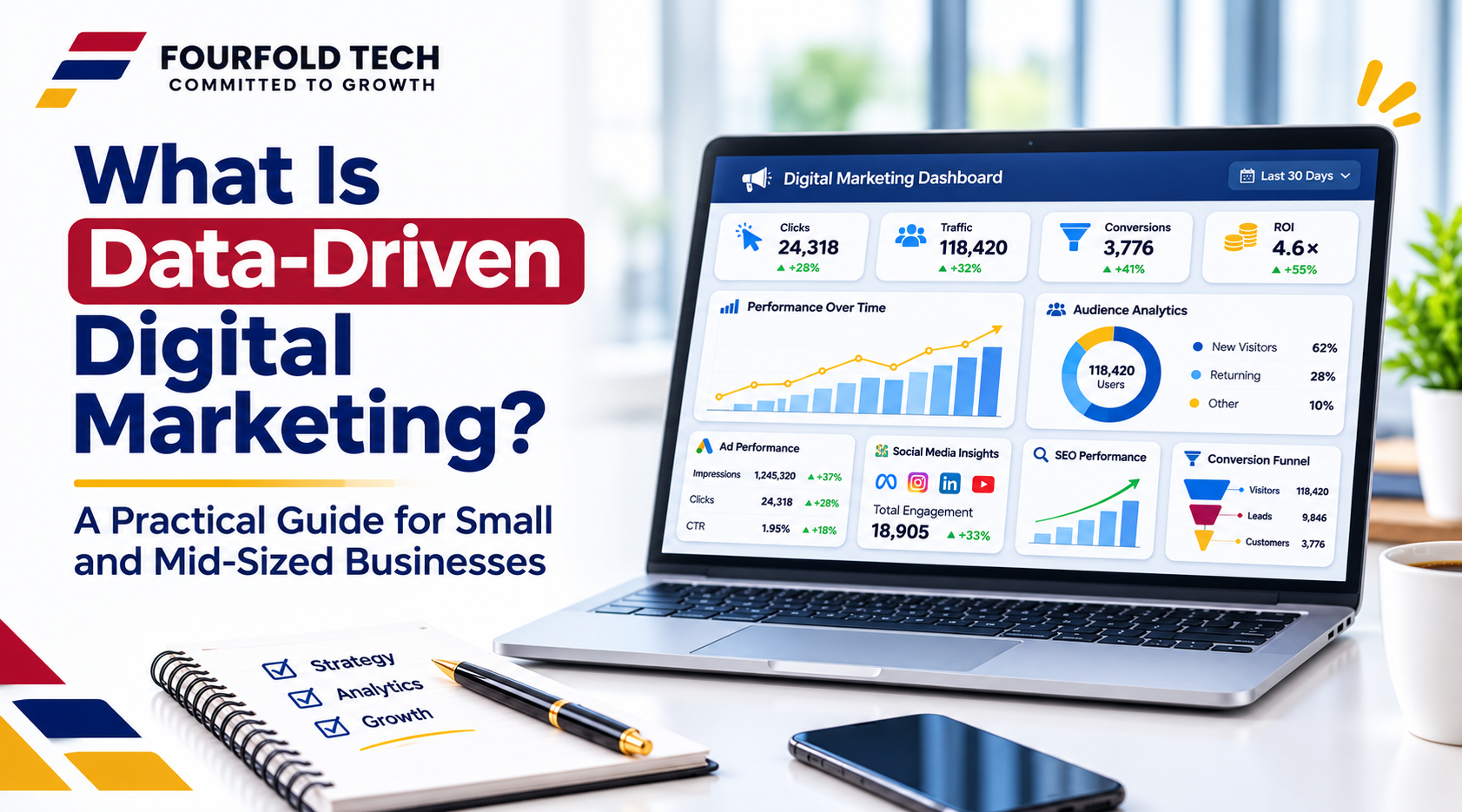
Most small businesses spend money on marketing every month, yet few can say which rupee, dirham or dollar actually brought in a customer. That gap is expensive. Data-driven digital marketing closes it. This guide explains what the term means, which numbers matter, and how to start this week, even without an analyst or a large budget.
What Is Data-Driven Digital Marketing?
Data-driven digital marketing means using real evidence to decide where to spend your time and money. That evidence comes from website behavior, ad results, search performance, email activity and customer records. Instead of asking “what do we think will work?”, you ask “what do the numbers show?”
Gut-feel marketing relies on opinions, habits and guesses about what competitors are doing. Data-driven marketing tests those ideas against results. Intuition still has a place, but data tells you whether it was right.
It also does not mean “big data” or a big budget. A business with a website, a Google Business Profile and a few campaigns already has enough information to make smarter decisions.
Why It Matters for Small and Mid-Sized Businesses
Smaller businesses have less room for error. Data helps in four ways:
- Every spend is justified. You can see which channels bring enquiries and which only bring clicks.
- You compete with larger brands. Better targeting and faster adjustments often beat a bigger budget.
- You waste less. Pausing the keywords, audiences or pages that do not convert frees money for those that do.
- You decide faster. Evidence replaces long debates.
As an illustration, imagine a business spending equally on three campaigns. A quick look at lead data shows one campaign produces most of the enquiries at half the cost. Moving budget toward it can lift results without raising total spend. That is the kind of decision data makes possible.
The Types of Data Every Business Should Use
- Website data: traffic, behavior, bounce rate and conversions.
- Customer data: CRM records, purchase history and enquiries.
- Advertising data: cost per click (CPC), click-through rate (CTR), cost per lead (CPL) and return on ad spend (ROAS).
- Social media data: reach, engagement and audience demographics.
- SEO data: keyword rankings, impressions and clicks.
- Email data: open rate, click rate and unsubscribes.
One distinction matters more every year: first-party data is information you collect yourself, such as form fills and purchases. Third-party data comes from outside sources. With stricter privacy rules and fewer tracking cookies, first-party data is more reliable and more valuable.
Key Metrics and KPIs to Track
Vanity metrics, like page views or follower counts, look good but rarely show business impact. Actionable metrics connect to leads and revenue. Match them to the funnel: awareness (reach, impressions), consideration (engagement, time on site), conversion (leads, sales) and retention (repeat purchases).
|
Metric |
What it tells you |
Where to find it |
|---|---|---|
| Conversion rate | Share of visitors who take action | GA4 |
| Cost per lead (CPL) | What each enquiry costs | Ad platforms, CRM |
| Customer acquisition cost (CAC) | Total cost to win a customer | CRM plus ad spend |
| Customer lifetime value (CLV) | Revenue a customer brings over time | CRM |
| ROI | Return against what you spent | Combined reports |
Essential Tools (Free and Paid)
You do not need an expensive stack. Start with free tools and scale as you grow:
- Google Analytics 4 and Google Search Console for website behavior and search visibility.
- Looker Studio for simple, shareable dashboards.
- Meta Ads Manager for social advertising results.
- Hotjar or Microsoft Clarity for heatmaps showing where visitors click and drop off.
- HubSpot or Zoho as a CRM to connect marketing to actual sales.
How to Build a Data-Driven Marketing Strategy
- Set clear, measurable goals. Use SMART goals, such as “increase qualified leads by 25% in six months.”
- Set up tracking correctly. Configure GA4, ad pixels and conversion events so key actions are recorded.
- Collect and organize your data. Bring website, ad and CRM data into one place, even a simple dashboard.
- Analyze and find insights. Look for patterns: which sources convert, which pages lose visitors, which audiences respond.
- Take action. Optimize campaigns, content and pages based on what you found.
- Test, measure and repeat. Use A/B testing to compare versions, keep what wins and repeat.
Common Mistakes to Avoid
- Tracking everything but acting on nothing.
- Chasing vanity metrics.
- Running with a poor or missing tracking setup.
- Ignoring data privacy and consent rules such as GDPR.
- Making decisions from too little data.
- Never connecting marketing data to real sales.
Most small businesses also face three practical hurdles: no in-house analyst, data scattered across platforms, and tight budgets. Simple dashboards, a short list of priorities and, where needed, an agency partner solve most of them.
How Fourfold Tech Can Help
Fourfold Tech helps small and mid-sized businesses turn marketing data into growth. We set up and audit GA4 and conversion tracking, build clear dashboards, improve SEO using Search Console insights, and optimize paid campaigns to lower cost per lead. Our approach is practical: fix the tracking, find what works, and put your budget behind it.
Conclusion
Data-driven marketing is not about complicated tools. It is about starting small, measuring consistently and improving continuously. Even a few well-chosen metrics can show you where your money works hardest.


